|
IEEE/ACM DS-RT 2016 The United Kingdom
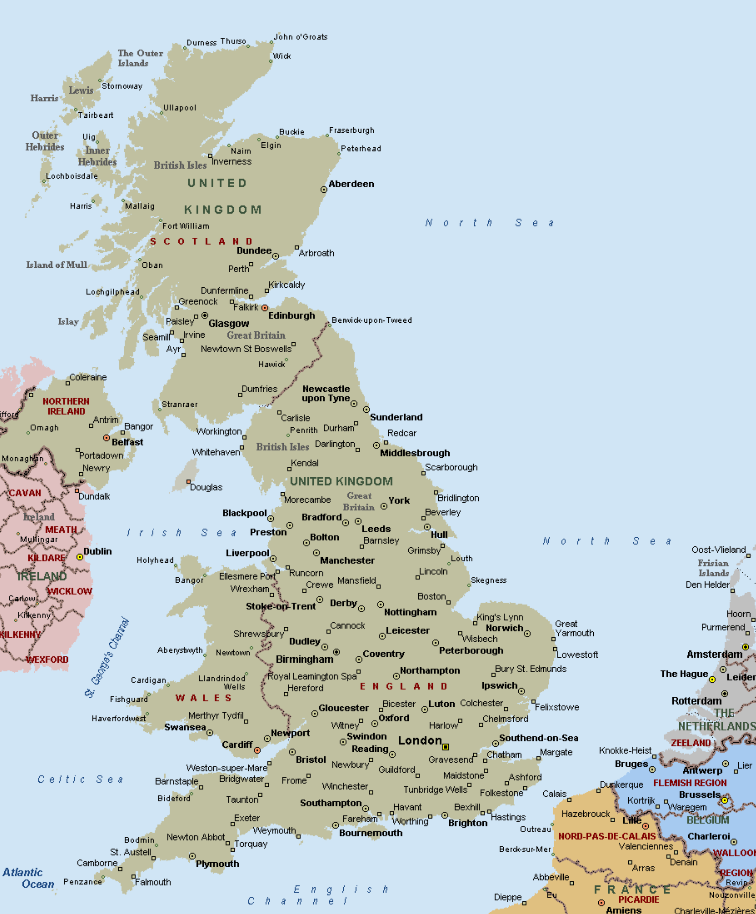
The United Kingdom of Great Britain and Northern Ireland, commonly known as the United Kingdom (UK) or Britain, is a sovereign state in Europe. Lying off the north-western coast of the European mainland, it includes the island of Great Britain (the name of which is also loosely applied to the whole country), the north-eastern part of the island of Ireland, and many smaller islands. Northern Ireland is the only part of the UK that shares a land border with another state - the Republic of Ireland. Apart from this land border, the UK is surrounded by the Atlantic Ocean, with the North Sea to its east, the English Channel to its south and the Celtic Sea to its south-southwest. The Irish Sea lies between Great Britain and Ireland. With an area of 93,800 square miles (243,000 km2), the UK is the 78th-largest sovereign state in the world and the 11th-largest in Europe. It is also the 21st-most populous country, with an estimated 65.1 million inhabitants Wikipedia United Kingdom.
The United Kingdom is the world's 8th biggest tourist destination, with 36.115 million visiting in 2015. The country's principal tourist destinations are in London, the capital city of the United Kingdom, with the Tower of London being the single most visited attraction in the country Wikipedia United Kingdom Tourism. London offers a wide variety of cultural and sport activities.
LanguageThe de facto official language of the United Kingdom is English, which is spoken by approximately 59.8 million residents, or 98% of the population, over the age of three. An estimated 700,000 people speak Welsh in the UK, an official language in Wales, and the only de jure official language in any part of the UK. Approximately 1.5 million people in the UK speak Scots-a language variety of English which some consider to be a distinct language. There are a small number of other living languages indigenous to the country, British Sign Language, Scottish Gaelic, Irish, and Cornish, various regional dialects, and numerous languages spoken by recent immigrant populations and those who have learnt them as second languages Wikipedia United Kingdom Languages.
Passports and VisasPlease follow the link to check whether you need a visa to visit the UK.
https://www.gov.uk/check-uk-visa
For attending the Symposium, the type of visa required is The Standard Visitor visa. For information on how to
apply please visit the following link.
https://www.gov.uk/standard-visitor-visa.
If you require an invitation letter for your visa application please contact the Local Arrangement Chair. Currency and BankingThe currency in the UK is the pound sterling (£), commonly known as the pound. There are 1p, 2p, 5p, 10p, 20p and 50p (pence) coins as well as £1 and £2 (pounds). Also, there are £5, £10, £20 and £50 notes. Credit cards, almost all major cards, are accepted at most restaurants and shops. ATMs can be found almost everywhere, operating 24/7, across the country and you can use most credit cards for cash withdrawals. Time Zone
In September, the UK uses British Summer Time (BST) which is one hour ahead of the Greenwich Mean Time
(GMT+01:00). ElectricityStandard power supply in the UK is 230V/50Hz (three-pin power outlet, type G). LondonLondon is a leading global city in the arts, commerce, education, entertainment, fashion, finance, healthcare, media, professional services, research and development, tourism, and transport. It is one of the world's leading financial centres and has the fifth-or sixth-largest metropolitan area GDP in the world. London is a world cultural capital. It is the world's most-visited city as measured by international arrivals and has the world's largest city airport system measured by passenger traffic. London is one of the world's leading investment destinations, hosting more international retailers and ultra high-net- worth individuals than any other city. London's universities form the largest concentration of higher education institutes in Europe, and a 2014 report placed it first in the world university rankings. According to the report London also ranks first in the world in software, multimedia development and design, and shares first position in technology readiness. London has a diverse range of peoples and cultures, and more than 300 languages are spoken within Greater
London. Its estimated mid-2015 population was 8,673,713, the largest of any city in the European Union, and
accounting for 12.5 per cent of the UK population. London's urban area is the second most populous in the EU,
after Paris, with 9,787,426 inhabitants at the 2011 census. The city's metropolitan area is one of the most
populous in Europe with 13,879,757 inhabitants, while the Greater London Authority states the population of
the city-region (covering a large part of the south east) as 22.7 million. London was the world's most populous
city from around 1831 to 1925.. London contains four World Heritage Sites: the Tower of London; Kew Gardens; the site comprising the Palace of Westminster, Westminster Abbey, and St Margaret's Church; and the historic settlement of Greenwich (in which the Royal Observatory, Greenwich marks the Prime Meridian, 0° longitude, and GMT). Other famous landmarks include Buckingham Palace, the London Eye, Piccadilly Circus, St Paul's Cathedral, Tower Bridge, Trafalgar Square, and The Shard. London is home to numerous museums, galleries, libraries, sporting events and other cultural institutions, including the British Museum, National Gallery, Tate Modern, British Library and West End theatres. The London Underground is the oldest underground railway network in the world. For more information, please visit the link: https://www.cityoflondon.gov.uk/things-to-do/visit-the-city/Pages/default.aspx |